Why Most Production Plans Collapse by Noon
The 30-Second Version
Production plans are made seriously — and still fall apart daily. Not because planning is bad, but because learning is missing. This story follows how plans quietly drift away from reality. And what separates planning theatre from real control.
The production plan is usually made with sincerity.
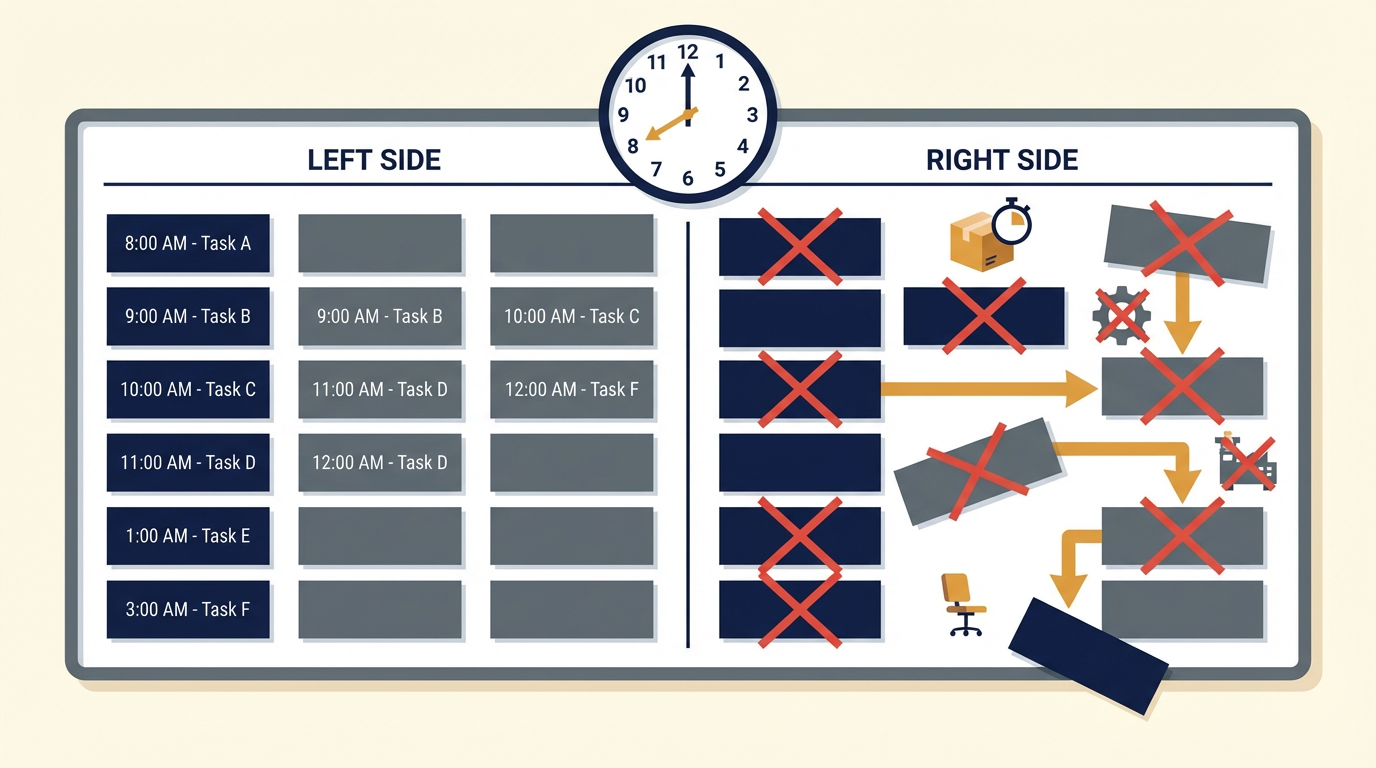
The night before, or early in the morning, supervisors and planners sit together. Orders are reviewed. Capacities are checked. Constraints are discussed. The plan is printed, shared, and sometimes even signed off.
For a brief moment, the factory feels under control.
And then the day begins.
By mid-morning, small cracks start appearing.
Material arrives late.
One machine runs slower than expected.
A quality hold blocks a batch.
An operator is absent.
Nothing dramatic.
Nothing unusual.
Yet, by noon, the plan no longer resembles reality.
The Quiet Collapse
What's important is this:
the plan doesn't collapse all at once.
It erodes.
A change here.
A workaround there.
A "we'll catch up later" decision.
By lunchtime:
Sequence has shifted
Priorities are unclear
Expediting begins
Yesterday's misses are still unresolved
The plan is still on paper.
But the factory has moved on.
Why This Feels Normal
Most factories accept this as the cost of doing business.
After all:
Demand is unpredictable
People are human
Machines fail
So deviations are treated as execution issues.
Supervisors are told to "manage better".
Operators are pushed to "go faster".
Planners update tomorrow's plan with today's excuses.
And firefighting becomes routine.
The problem is not that plans change.
The problem is that nothing is learned from those changes.
The Missing Feedback Loop
In one SME factory, a leadership team decided to observe, not intervene.
For a week, they simply tracked:
What was planned
What actually happened
When the plan first deviated
Why it deviated
What they saw was revealing.
Most deviations occurred in the first two hours of the shift.
Once the first miss happened, everything downstream adjusted informally.
No escalation.
No structured discussion.
No countermeasure.
By the end of the day, the plan had been rewritten — mentally — several times.
But none of that learning made it into tomorrow.
When Plans Become Fiction
Over time, something subtle happens.
People stop believing in the plan.
They look at it, nod, and immediately start preparing for deviations.
"Let's see how long this one lasts."
"This will change anyway."
The plan turns into a formality.
A document that signals intent — not control.
And when leaders ask why targets aren't met, the answers sound familiar:
Too many changes
Too many urgencies
Too many constraints
All true.
And yet, none of them explain why the same issues repeat every single day.
The Real Issue
Good planning is not about predicting the day perfectly.
It's about detecting deviation early and responding deliberately.
In most factories:
Deviations are noticed late
Discussed informally
Resolved locally
Forgotten quickly
There is no rhythm that converts disruption into learning.
So tomorrow looks exactly like today.
The Lean Angle
What can Indian SME owners learn from this?
1. Plans are hypotheses, not promises Their value lies in what they reveal when they fail.
2. Firefighting is a system outcome When deviations aren't surfaced early, chaos fills the gap.
3. Morning misses matter most The earlier the deviation, the greater its downstream impact.
4. Learning beats control Factories improve when plans create insight, not pressure.
The Bigger Lesson
Here's to plans that teach — not just promise.
If this made you pause or rethink something, pass it on to a fellow operator, plant head, or business owner. Inspiring stories are meant to be shared on WhatsApp, LinkedIn, or wherever good ideas travel.
Share this story: