Why SME Factories Hit a 40–45% Efficiency Ceiling
The 30-Second Version
Across industries, many SME factories get stuck at the same efficiency level. Not because people don't work hard — but because systems work against them. This story explores the invisible ceiling most factories don't see. And what actually helps break through it.
Walk into enough Indian SME factories and a strange pattern begins to emerge.
Different industries.
Different products.
Different owners.
Yet the numbers look uncannily similar.
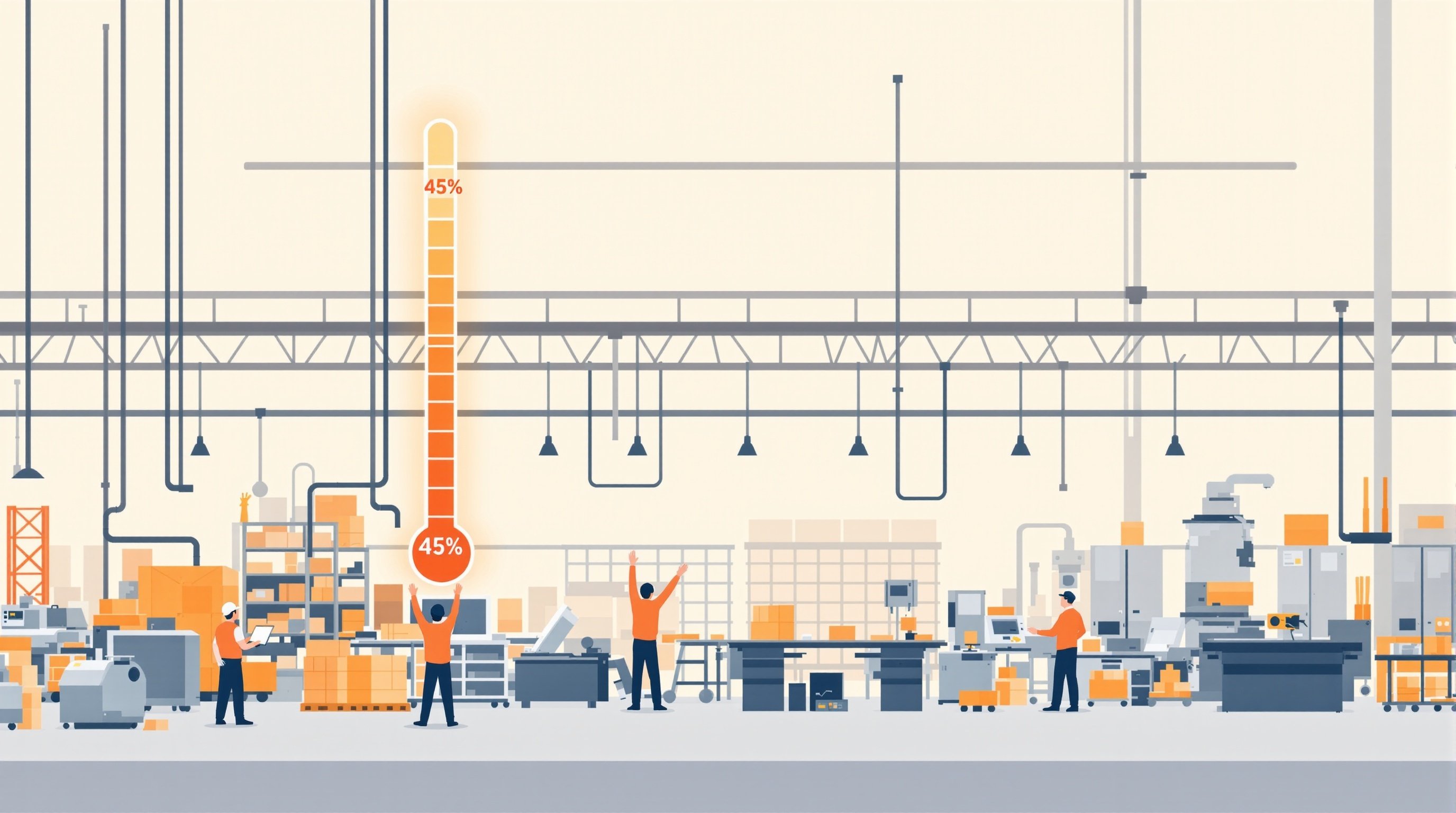
Overall efficiency hovers around 40–45%.
Occasionally it touches 50% in a good month.
Rarely does it stay above that for long.
Ask the owner what's going wrong, and the answers come quickly.
"Labour discipline is weak."
"Breakdowns are too frequent."
"Planning keeps changing."
"We need better machines."
All reasonable explanations.
And yet, none of them explain why so many factories hit the same ceiling.
Because the real constraint isn't effort.
It's the system.
The Invisible Ceiling
Most SME factories don't realise they're operating under an invisible ceiling — until they try to push past it.
They add manpower.
They extend overtime.
They push supervisors harder.
They invest in one new machine.
Efficiency jumps briefly.
Then, quietly, it settles back to the familiar 40–45%.
Why?
Because the factory is optimised locally, not end-to-end.
Each function does what it believes is right:
Production chases output
Quality chases defects
PPC chases schedules
Maintenance chases breakdowns
Everyone is busy.
No one is aligned.
Waiting hides as "manpower shortage".
Rework hides as "customer urgency".
Excess WIP hides as "buffer".
Firefighting becomes normal — even respectable.
The factory isn't broken.
It is behaving exactly as its system allows.
The Turning Point
In one mid-sized engineering unit, leadership decided to stop guessing.
They didn't buy software.
They didn't hire consultants.
They didn't conduct workshops.
Instead, for two weeks, they tracked just one thing:
Where does time actually go?
The answer was uncomfortable.
Jobs waiting for material
Operators waiting for approvals
Machines waiting for the "right" order
Finished parts waiting for inspection
Actual value-adding work occupied less than half the available time.
The ceiling wasn't human.
It was structural.
What Changed
Instead of pushing people harder, leadership changed the rules of work.
Clear daily priorities replaced shifting instructions
WIP limits replaced "just keep running"
Quality checks moved upstream
Maintenance shifted from reactive to planned
Daily reviews focused on problems, not blame
No heroics.
No slogans.
No motivational speeches.
Just clarity.
Within three months, efficiency moved from 42% to 58%.
Not because people worked more —
but because waste stopped working against them.
The Lean Angle
What can Indian SME owners learn from this?
1. Efficiency ceilings are system signals When different factories hit the same limit, it's not coincidence. It's a design issue.
2. Local optimisation kills global performance Departments can look "efficient" individually while the factory as a whole struggles.
3. Firefighting is structural, not cultural When priorities, information, and flow are unclear, firefighting is inevitable.
4. Flow beats effort When work moves smoothly, productivity improves without burnout.
The Bigger Lesson
Here's to fewer firefights and more flow.
If this made you pause or rethink something, pass it on to a fellow operator, plant head, or business owner. Inspiring stories are meant to be shared on WhatsApp, LinkedIn, or wherever good ideas travel.
Share this story: