The Hidden Cost of Absenteeism — and Why Overtime Isn't the Answer
The 30-Second Version
When one person is absent, the whole system often wobbles. Overtime feels like a fix — but it quietly creates new problems. This story reframes absenteeism as a system stress test. And explains how resilient factories design for reality.
In many factories, absenteeism is treated as a people problem.
"Attendance is poor."
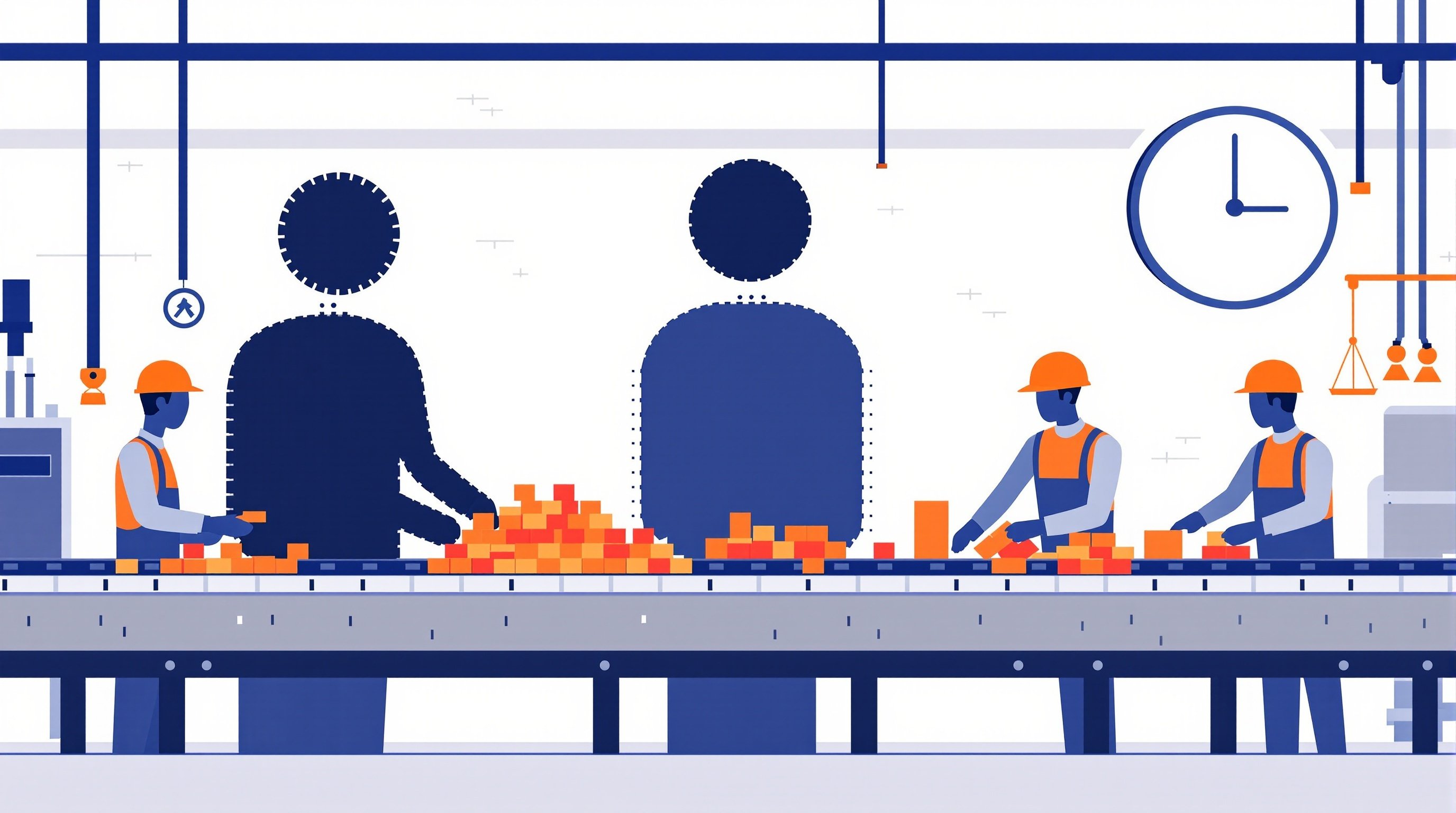
"Today again, two operators didn't show up."
"We'll manage — put overtime."
And just like that, the solution is decided.
Lines are stretched.
Supervisors reshuffle people.
Overtime approvals go out by noon.
The day somehow gets completed.
But what's rarely discussed is the cost of that 'somehow'.
What Actually Breaks When One Person Is Absent
When an operator is absent, the immediate concern is output.
But the real damage happens elsewhere.
A skilled operator is pulled from another line
A less experienced person fills in
Cycle times change
Quality checks get rushed
Fatigue sets in by the second half
The factory doesn't just lose one person.
It loses stability.
And instability compounds quietly.
The Overtime Illusion
Overtime feels like a practical fix.
It's visible.
It's decisive.
It signals urgency.
But overtime doesn't restore capability.
It masks the loss — temporarily.
In one SME factory, leadership noticed a pattern:
Absenteeism averaged 6–8%
Overtime averaged 12–15%
Quality rejections peaked on overtime-heavy days
On paper, attendance was the issue.
In reality, the system had no resilience.
Why Absenteeism Hurts More Than We Admit
Absenteeism exposes three uncomfortable truths.
First, skills are concentrated, not distributed.
One "go-to" operator holds critical knowledge.
Second, standard work is weak or informal.
Processes depend on familiarity, not structure.
Third, line design assumes full attendance.
There is no buffer for real-world variability.
So when one person is missing, the factory improvises.
Every day.
When Overtime Becomes the Default
Over time, overtime stops being an exception.
It becomes part of the plan.
Targets quietly assume extra hours
Fatigue is normalised
Learning slows down
Errors increase
Ironically, overtime often increases absenteeism:
Burnout rises
Morale dips
Recovery time disappears
The system enters a loop it can't escape.
The Turning Point
In one unit, leadership stopped asking:
"Who is absent today?"
Instead, they asked:
"Which processes break when one person is missing?"
The answers were revealing.
Certain machines had only one trained operator
Some quality checks had no backup
Changeovers depended on informal know-how
Absenteeism wasn't the root cause.
It was the stress test.
What Changed
Instead of tightening attendance rules, the factory worked on resilience.
Critical operations were identified
Skill matrices were built honestly
Backups were trained deliberately
Standard work was documented and simplified
Lines were rebalanced for flexibility
Absenteeism didn't disappear.
But its impact reduced sharply.
Overtime dropped.
Quality stabilised.
Supervisors stopped scrambling.
The system could breathe.
The Lean Angle
What can Indian SME owners learn from this?
1. Absenteeism is not the disease It reveals how fragile the system really is.
2. Overtime is a symptom, not a solution If it's regular, something upstream is broken.
3. Resilience beats efficiency A slightly slower but flexible line outperforms a fragile fast one.
4. Skills must belong to the system, not individuals Otherwise, absence becomes disruption.
The Bigger Lesson
Here's to fewer emergencies and stronger teams.
If this made you pause or rethink something, pass it on to a fellow operator, plant head, or business owner. Inspiring stories are meant to be shared on WhatsApp, LinkedIn, or wherever good ideas travel.
Share this story: